What causes corrosion of copper pipes in borehole water?
Borehole pumps
HOW TO AVOID CORROSION IN COPPER PIPE
One of the most significant milestones in our lives is when we are finally able to purchase a property! It’s something most people dream of and work diligently towards achieving. It takes hard work and effort to achieve this so naturally, you want to make sure you do everything in your power to take care of it. If your property has copper piping and you’re using borehole or well-point water then it’s imperative to ensure that you avoid corrosion in your copper pipe. This is due to the cost of plumbing repairs, expenses that can arise from repairing water-damaged materials, and even mold issues. It’s simply not something that can or should be ignored!
Copper has typically been a favored choice for piping water to numerous households. The reason for this is obvious when you consider the fact that it has strong corrosion resistance and can last for many years. It seems to be an easy, clear-cut choice, doesn’t it?
While copper piping is generally a safe choice when it comes to council water it’s another story entirely when it comes to water sourced from well-points and boreholes. Corrosion of copper piping is typically associated with water that is used from a borehole or well-point.
When you decide to drill a well-point or borehole and use that water inside your home by means of copper piping you need to test it first and treat it if necessary to ensure you don’t end up with copper corrosion issues.
Let’s take a closer look now at what copper pipe corrosion is.
WHAT IS COPPER PIPE CORROSION?
According to Wikipedia, corrosion is defined as “the gradual destruction of materials (usually a metal) by chemical and/or electrochemical reaction with their environment”. As a result, when copper pipes are used to convey water, they can become susceptible to erosion. While copper is corrosion resistant it is not corrosion-proof. What this means is that when it is exposed to specific chemicals found in water, in particular, those found in borehole or well point water, then corrosion can occur over time.
WHAT ARE SOME OF THE MAIN CAUSES OF COPPER PIPE CORROSION?
- pH levels of the water
- High levels of dissolved oxygen
- High levels of salts dissolved in the water
- High velocity of the water
Let’s take a closer look now at each of these causes:
1. PH LEVELS OF THE WATER
To understand this let’s first look at what pH actually means. pH is a way to measure the electrically charged particles in a substance. It shows whether the water is acidic, neutral, or alkaline based on a reading from a pH scale that ranges from 0 – 14. A reading between 0 – 6 indicates that it’s acidic with the most acidic substances showing a pH of 0. A reading between 8 – 14 indicates alkalinity. A pH reading of 7 indicates pure water because 7 is neutral. It’s neither acidic nor alkaline.
In light of this, we can see that a high acidic pH level in the water will increase corrosion by providing hydrogen ions to the corrosion process.
As a result, it’s important to note that water with a pH between 7.0 and 8.2 is usually not corrosive. By contrast, water that shows a pH of 6.5 and below will be corrosive.
2. HIGH LEVELS OF DISSOLVED OXYGEN
Dissolved oxygen is the amount of oxygen found in water. Numerous metals are coated with a protective hydrogen film but this can be destroyed by dissolved oxygen. As a result, oxygen comes into contact with the copper and oxides it which causes the pipes to rust.
3. HIGH LEVELS OF SALTS DISSOLVED IN THE WATER
When it comes to corrosion from high levels of salt, copper is the metal that is most susceptible to it. High salt levels in the water contribute to corrosion because it’s an electrolyte. As a result, it conducts ions which accelerates the rusting process.
4. HIGH VELOCITY OF THE WATER
This can cause corrosion as the abrasive particles in the water scour against and erode the protective film which is usually found on the inside surface of the pipes. This can lead to pinholes forming in the pipes and ultimately to corrosion.
WHAT TYPE OF CORROSION CAN OCCUR?
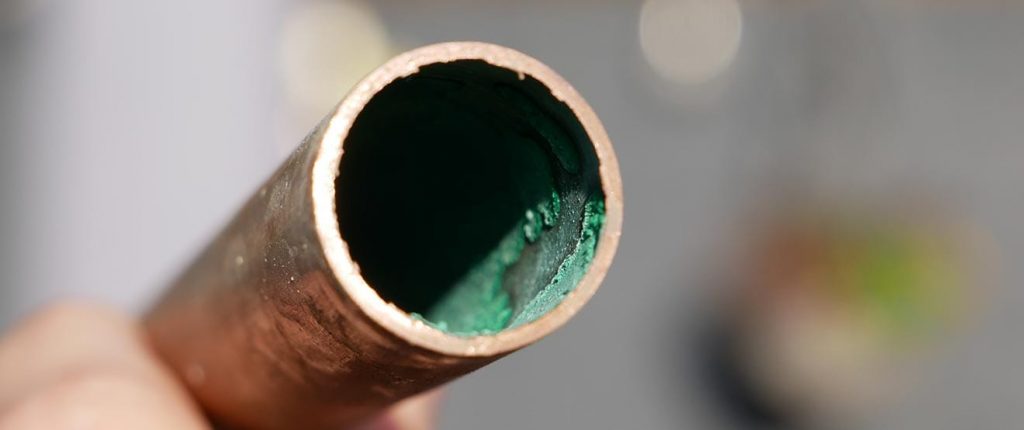
The main type of erosion that occurs in copper pipes is pitting corrosion. Here’s how it works. When the copper pipe comes into contact with chemicals like chloride, hypochlorite, or bromide ions that are found in the water it causes a reaction on the copper. It starts as little patches that have the appearance of a greenish spot. These weaken the copper over time which causes pinhole leaks. These can be difficult to locate and can lead to much damage and water wastage.
Now that we understand copper pipe corrosion and have looked at what causes it, let’s explore the various options available to you to deal with it.
The first step is to draw a water sample and have it tested at a laboratory. They will give you a full report on the quality of your water. Your water systems specialist will treat your water according to these results.
PLEASE CLICK HERE TO GET A WATER SAMPLE DONE TODAY
The important thing to note is that they will indicate the correct amount for each substance. It will also let you know if your water is on par and can be used for drinking water. It’s very important to take note of the Langelier index which tells you how corrosive the water is.
4 WAYS TO DEAL WITH COPPER PIPE CORROSION
1. PH LEVELS
If the laboratory tests show that the pH levels of your water are too acidic then a corrosion-resistant chemical feed pump will be installed that will release sodium hydroxide solution into the water. This will raise the pH level of your water making it alkaline. Ideally, you are looking to have the pH level around 7 for your water.
Alternatively, a pressure vessel filled with calcite can also be used to raise the pH level of your water.
2. HIGH LEVELS OF DISSOLVED OXYGEN
Reducing dissolved oxygen levels can be challenging. However, a flexible membrane or floating disc can be added to the pressure tank. This will help reduce the water’s contact with air.
3. HIGH LEVELS OF SALTS DISSOLVED IN THE WATER
If your water testing results reveal that your salt levels are too high then a reverse osmosis system will need to be installed.
Reverse osmosis refers to the way in which water is processed and treated so that salts are removed from the water. This is achieved by using pressure that forces the water molecules through a semipermeable membrane. As a result, the salt gets trapped in the semipermeable membrane where it is filtered and flushed out. All that’s left now is clean drinking water.
4. HIGH VELOCITY OF THE WATER
If you need to reduce the flow rate (velocity) of your water then consider using larger diameter pipes which can slow the flow rate of the water down.
The velocity for a pipe with cold water should be around 2.4 meters per second.
Copper pipe corrosion can be a factor for people using underground borehole and well-point water. However, it’s something that can be addressed and dealt with through the above-mentioned methods.
In these uncertain times in which we live having your own source of water is essential. Equally essential is ensuring your underground water is clean, drinkable, and not running through corroded copper pipes. It takes a willingness to be proactive and the decision to invest some money into it but it’s the best investment you’ll ever make! Never forget, water is life!
Signs of Copper Pipe Corrosion
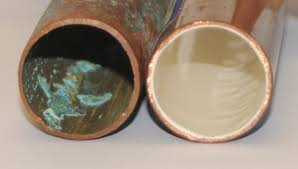
One of the main symptoms of pipe corrosion is blue-green stains on your sinks, showers, faucets, drains, and other plumbing fixtures. The copper pipe green corrosion is caused by the copper being dissolved out of the pipes and then deposited elsewhere. You may also find tiny, pinhole leaks in your pipes as the copper is slowly worn away.
What Causes Pipe Corrosion?
If your plumbing fixtures show signs of copper pipe corrosion, you should first check the pH of the water. Water with a low pH, also called acid water, can corrode all types of pipes. If you test your water and the pH is close to neutral, however, then there is likely something else causing the problem. Common issues that cause corrosion include a high level of dissolved oxygen (called oxygen corrosion), pipes that were not installed correctly, improper electrical grounding, high flow rates, and a lot of sediment in the water.
Unfortunately, it’s not always possible to determine what’s causing waterline corrosion. Even if you’re not sure of the cause, there are ways to remove the unattractive staining and prevent it from developing again.
The Dangers of Copper Pipe Corrosion
If at all possible, you should try to determine the cause of corrosion in your pipes. Humans need a small amount of copper, which is an essential nutrient, but too much can cause gastrointestinal problems. Exposure to high copper levels over time can lead to liver or kidney damage. You should take action if testing reveals copper over 1.0 milligram per liter (mg/l).
Treating Corrosion
Water that is not acidic but still causes blue-green stains should not be treated with a water neutralizer “ it won’t solve the problem. In these cases, the water corrosion isn’t caused by acid, so raising the pH typically won’t do anything to help. Your next step should be to check if the electrical system in your home is grounded properly. An incorrectly grounded system can cause stray currents to corrode pipes, as can combining galvanized and copper pipes. Excessive flux or the improper de-burring of copper pipes can also cause both staining and leaks, as well. All of these issues can be addressed and corrected.
If you cannot determine what is causing the copper pipe corrosion, you can still eliminate the blue-green stains. Polyphosphate injection systems are often used to inhibit the development of scale and control corrosion. This water treatment keeps minerals ” including copper ” suspended in the water so that it cannot build up on plumbing fixtures, reducing or eliminating the stains. In addition, many of these chemicals help provide a protective coating on pipes, reducing corrosion.
Please contact us for a free assessment of your water
Questions, Comments? You tell us. We listen.
Email: aquifywater@gmail.com
Monday to Saturday – 9:00 am to 5:00 pm
Need Us? Call Us.
084 6023557
Check out this thread on Quora
https://www.quora.com/Should-I-be-worried-about-blueish-corrosion-on-my-copper-pipes